> ## Documentation Index
> Fetch the complete documentation index at: https://link.datarelay.run/llms.txt
> Use this file to discover all available pages before exploring further.
# Deployment Modes
> Choose between Direct and Enterprise single-443 deployments.
# Deployment Modes
Data Relay Link has **two** server deployment modes: **Direct** and **Enterprise single-443**.
NAT is not a third mode; it is a network topology around either deployment.
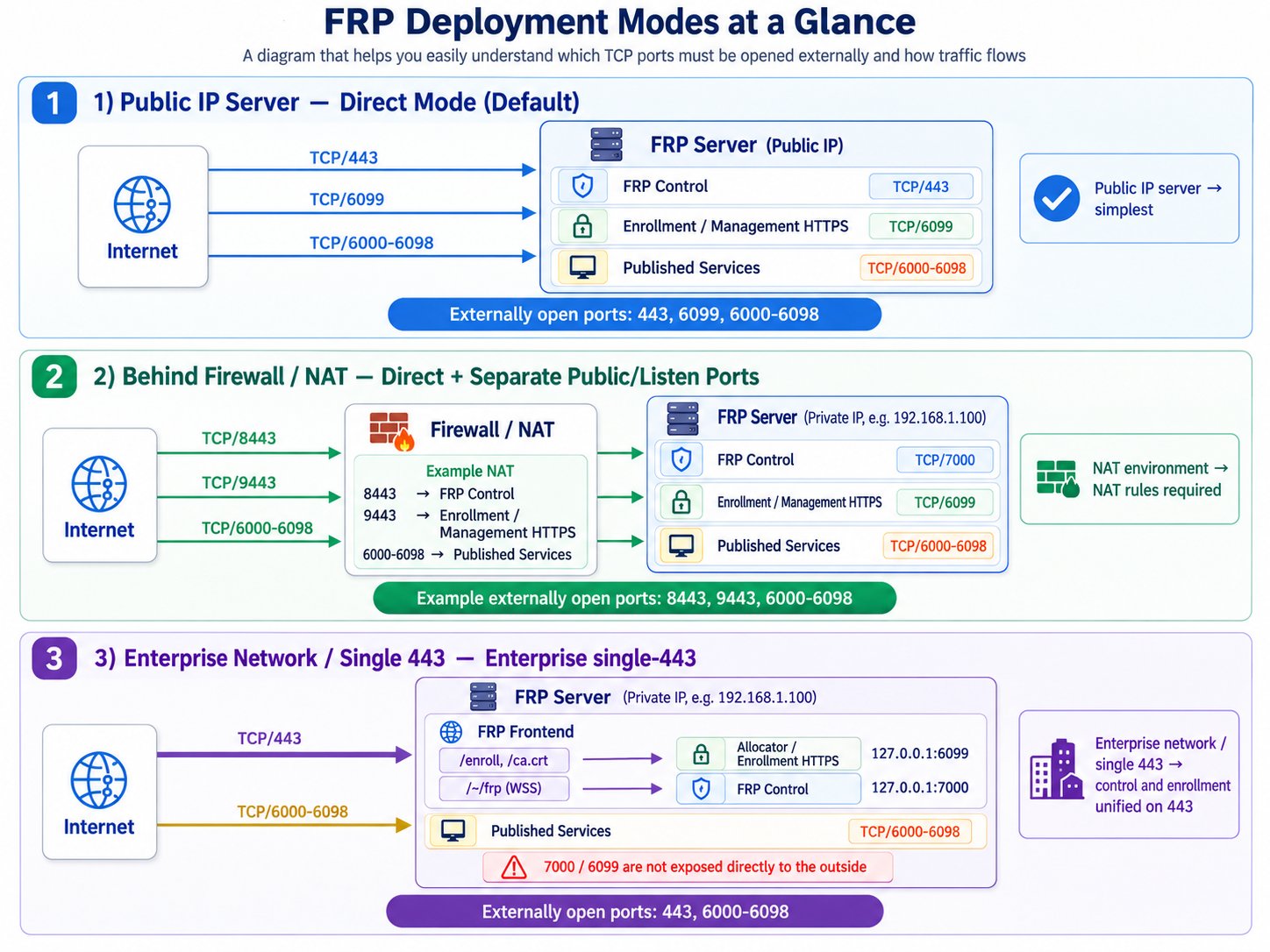 The image is the original field-guide overview: a direct public server, a private server behind DNAT, and the Enterprise single-443 layout. The tables below use the current v2.2.1 terminology and port rules.
## Which mode should I choose?
```mermaid theme={null}
flowchart TD
A[Start] --> B{Does the client network allow\nverified HTTPS / Data Relay Link traffic\non the normal public endpoints?}
B -->|Yes| D[Use Direct\nrecommended default]
B -->|No / TLS on non-443 is reset| C{Can public TCP 443\nbe used for both enrollment\nand Data Relay Link control?}
C -->|Yes| S[Use Enterprise single-443]
C -->|No| N[Fix upstream network policy\nData Relay Link does not support insecure fallback]
```
## Direct mode
```mermaid theme={null}
flowchart LR
C[Remote client]
I[Internet]
S[Data Relay Link server]
U[Internet user]
C -->|Data Relay Link control TCP 443| S
C -->|Enrollment/management HTTPS TCP 6099| S
U -->|Published service TCP 6000-6098| S
```
Direct is the default and easiest mode to reason about.
| Purpose | Public TCP | Typical local listen |
| ----------------------------- | ---------: | -------------------: |
| Data Relay Link control | 443 | 443 |
| Enrollment / management HTTPS | 6099 | 6099 |
| Published services | 6000-6098 | 6000-6098 |
## Enterprise single-443
Use this when an enterprise client network strongly prefers TLS on TCP/443 or allows the TCP connection to a non-standard port but resets TLS there.
```mermaid theme={null}
flowchart LR
C[Remote client]
U[Internet user]
FE[Public frontend\nTCP 443]
A[Allocator backend\n127.0.0.1:6099]
F[Data Relay Link backend\n127.0.0.1:7000]
P[Published ports\n6000-6098]
C -->|HTTPS enrollment| FE
C -->|Data Relay Link control over WSS| FE
FE --> A
FE --> F
U --> P
```
In single-443 mode, backend ports `6099` and `7000` are not intended to be Internet-exposed.
## Side-by-side summary
| Question | Direct | single-443 |
| ------------------------------ | ------------------------ | ------------------------------------------- |
| Normal default? | **Yes** | No, use for constrained enterprise networks |
| Public Data Relay Link control | TCP 443 | TCP 443 via WSS frontend |
| Public enrollment HTTPS | TCP 6099 | TCP 443 |
| Published services | 6000-6098 | 6000-6098 |
| Backend 6099 | public/listen by default | loopback backend |
| Backend 7000 | not normal Direct path | loopback Data Relay Link backend |
## Server behind firewall/NAT
Either mode can be placed behind a firewall/NAT device if the public endpoints are forwarded correctly.
```mermaid theme={null}
flowchart LR
C[Remote client] -->|public endpoint| F[Firewall / NAT]
F -->|DNAT| S[Private Data Relay Link server]
```
For a Direct example with public-to-private port translation, see [Firewall & NAT](/deployment/firewall-nat).
## Switching modes
Direct ↔ single-443 is a maintenance-window cutover, not a zero-downtime change. Persistent identity, CA, token, registry, and port reservations are designed to remain, but the client transport must match the new topology.
After any mode change:
```bash theme={null}
sudo drlink show status
sudo drlink doctor
```
Do not solve TLS interception/reset by disabling certificate verification or by switching enrollment to plain HTTP. The supported management plane remains verified HTTPS.
The image is the original field-guide overview: a direct public server, a private server behind DNAT, and the Enterprise single-443 layout. The tables below use the current v2.2.1 terminology and port rules.
## Which mode should I choose?
```mermaid theme={null}
flowchart TD
A[Start] --> B{Does the client network allow\nverified HTTPS / Data Relay Link traffic\non the normal public endpoints?}
B -->|Yes| D[Use Direct\nrecommended default]
B -->|No / TLS on non-443 is reset| C{Can public TCP 443\nbe used for both enrollment\nand Data Relay Link control?}
C -->|Yes| S[Use Enterprise single-443]
C -->|No| N[Fix upstream network policy\nData Relay Link does not support insecure fallback]
```
## Direct mode
```mermaid theme={null}
flowchart LR
C[Remote client]
I[Internet]
S[Data Relay Link server]
U[Internet user]
C -->|Data Relay Link control TCP 443| S
C -->|Enrollment/management HTTPS TCP 6099| S
U -->|Published service TCP 6000-6098| S
```
Direct is the default and easiest mode to reason about.
| Purpose | Public TCP | Typical local listen |
| ----------------------------- | ---------: | -------------------: |
| Data Relay Link control | 443 | 443 |
| Enrollment / management HTTPS | 6099 | 6099 |
| Published services | 6000-6098 | 6000-6098 |
## Enterprise single-443
Use this when an enterprise client network strongly prefers TLS on TCP/443 or allows the TCP connection to a non-standard port but resets TLS there.
```mermaid theme={null}
flowchart LR
C[Remote client]
U[Internet user]
FE[Public frontend\nTCP 443]
A[Allocator backend\n127.0.0.1:6099]
F[Data Relay Link backend\n127.0.0.1:7000]
P[Published ports\n6000-6098]
C -->|HTTPS enrollment| FE
C -->|Data Relay Link control over WSS| FE
FE --> A
FE --> F
U --> P
```
In single-443 mode, backend ports `6099` and `7000` are not intended to be Internet-exposed.
## Side-by-side summary
| Question | Direct | single-443 |
| ------------------------------ | ------------------------ | ------------------------------------------- |
| Normal default? | **Yes** | No, use for constrained enterprise networks |
| Public Data Relay Link control | TCP 443 | TCP 443 via WSS frontend |
| Public enrollment HTTPS | TCP 6099 | TCP 443 |
| Published services | 6000-6098 | 6000-6098 |
| Backend 6099 | public/listen by default | loopback backend |
| Backend 7000 | not normal Direct path | loopback Data Relay Link backend |
## Server behind firewall/NAT
Either mode can be placed behind a firewall/NAT device if the public endpoints are forwarded correctly.
```mermaid theme={null}
flowchart LR
C[Remote client] -->|public endpoint| F[Firewall / NAT]
F -->|DNAT| S[Private Data Relay Link server]
```
For a Direct example with public-to-private port translation, see [Firewall & NAT](/deployment/firewall-nat).
## Switching modes
Direct ↔ single-443 is a maintenance-window cutover, not a zero-downtime change. Persistent identity, CA, token, registry, and port reservations are designed to remain, but the client transport must match the new topology.
After any mode change:
```bash theme={null}
sudo drlink show status
sudo drlink doctor
```
Do not solve TLS interception/reset by disabling certificate verification or by switching enrollment to plain HTTP. The supported management plane remains verified HTTPS.