Server Installation
The Data Relay Link server is the public entry point. It runs the bundled relay-server runtime plus enrollment, registry, lifecycle, anddrlink management components.
Recommended first environment
For the simplest first deployment, use an Ubuntu 24.04 x86_64 server with a direct public IP. Ubuntu 24.04 is the clearest Real E2E-validated server baseline for the stable release; Ubuntu 22.04 has automated portability coverage but is not presented as an equivalent real-host validation claim. Other Linux families have different validation levels; see Supported Platforms.Choose the topology first
The original field guide summarized the three common network layouts in one diagram. Use it as a visual map before choosing the actual product mode.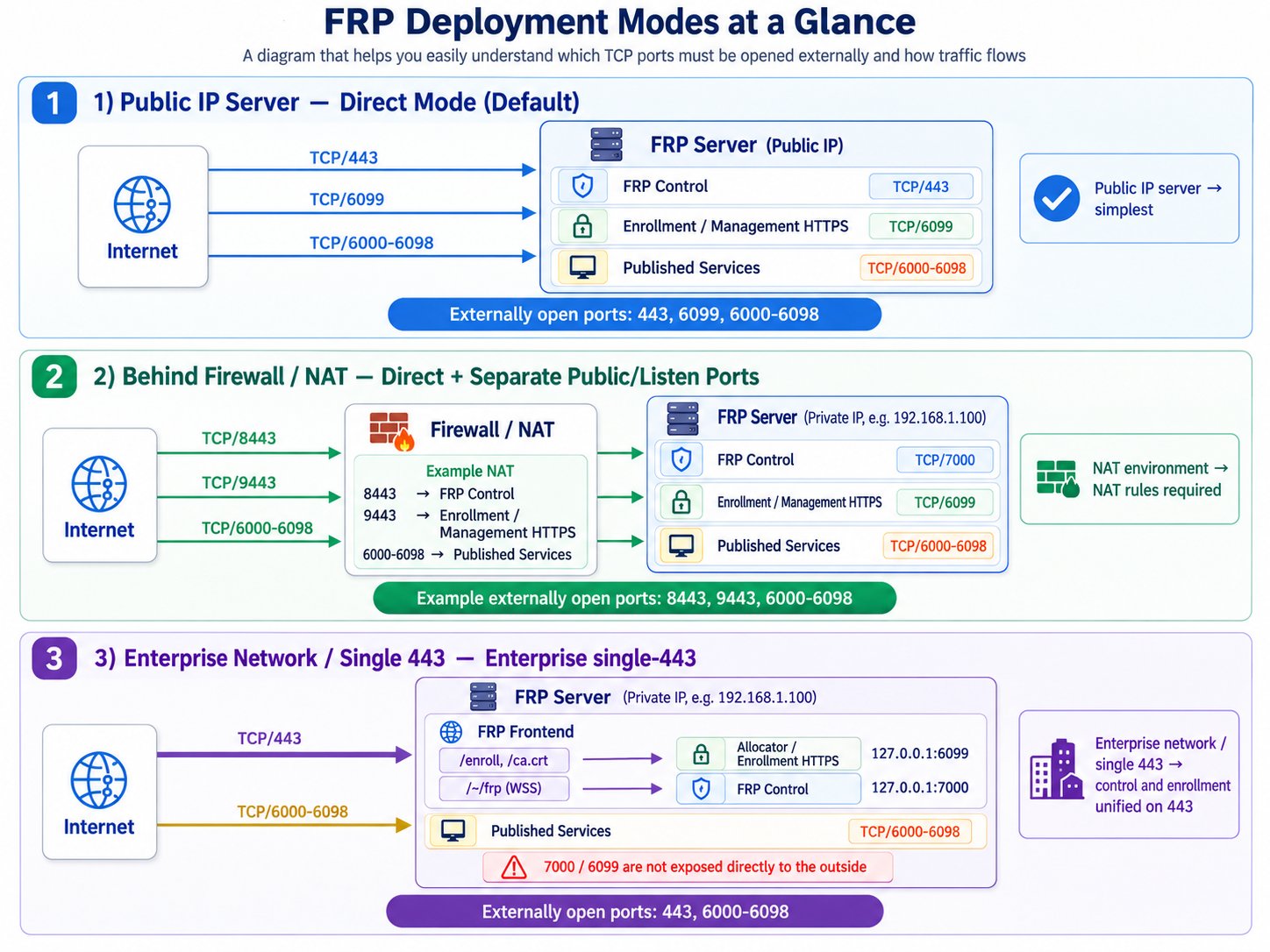
The diagram shows Direct, Direct behind NAT, and Enterprise single-443 as network layouts. NAT itself is not a third product mode; the product modes are Direct and Enterprise single-443.
NAT is a network topology, not a third Data Relay Link mode. The two product modes are Direct and Enterprise single-443.
Direct mode defaults
TCP/22 is optional for your own administrative SSH access to the server; it is not part of the Data Relay Link tunnel path.If the server is behind NAT
Example: Clients must use the public control/enrollment endpoints, not the server’s private address. See Firewall & NAT.Install the current stable release
Current published stable: v2.2.1 with bundled/tested relay engine v0.71.0.main unless you intentionally want development behavior.
What the installer asks for
Expect questions about:- public IP / public control endpoint
- optional public service hostname
- internal server IP
- Direct vs Enterprise single-443
- public and local control ports
- public and local enrollment/allocator ports
- published service range
Verify immediately after installation
doctor is read-only and checks installation state, permissions, PKI, service state, registry consistency, topology, and common network problems.
Persistent state you should understand
Server readiness checklist
- required systemd services are active
drlink doctorhas no blocking finding- public control/enrollment endpoints are reachable from the client network
- published service range is allowed by the server-side firewall/NAT
- if using DNS, the public hostname resolves to the correct public entry point